

2. Theoretical Background#
2.1. Sensors#
Empatica E4 (Real-time physiological signal sensoring)
Polar H10 (Real-time heart rate signal sensoring)
Azure Kinect Developer Kit (3D spatial information sensor device to create computer vision and speech model applications)
2.1.1. Specifications#
Device |
Sensors |
Data Stream |
Frequency (set to) |
Output |
|---|---|---|---|---|
Empatica E4 |
Photoplethysmography sensor (PPG) |
Blood Volume Pressure (BVP) |
64Hz |
.csv |
Heart Rate (HR) |
event-based (derived from BVP) |
.csv |
||
Interbeat Interval (IBI) |
event-based (derived from BVP) |
.csv |
||
Electrodermal activity sensor (EDA) |
Galvanic skin response (GSR) |
4Hz |
.csv |
|
3-axis accelerometer |
XYZ-axes per timestep (ACC) |
32Hz |
.csv |
|
Optical thermometer (probably infrared) |
Skin temperature |
4Hz |
.csv |
Device |
Sensors |
Data Stream |
Frequency (set to) |
Output |
|---|---|---|---|---|
Polar H10 |
Electrocardiography sensor (ECG) |
ECG data (ECG) |
130Hz |
.csv |
Interbeat Interval (IBI) |
event-based (derived from ECG) |
.csv |
||
Heart Rate (HR) |
event-based (derived from ECG) |
.csv |
||
3-axis accelerometer (XYZ) |
XYZ-axes per timestep (ACC) |
200Hz |
.csv |
[Polar, 2024], [Määttä, 2024]
Device |
Sensors |
Data Stream |
Frequency (set to) |
Output |
|---|---|---|---|---|
Azure Kinect DK |
Depth camera: 1MP Time-of-flight |
NFOV unbinned: 640x576 NFOV 2x2 binned: 320x288 WFOV 2x2 binned: 512x512 WFOV unbinned: 1024x1024 Passive IR: 1024x1024 |
0, 5, 15, or 30 FPS |
- |
RGB camera: 12MP CMOS sensor rolling shutter |
3840x2160 (UHD)2560x1440 (QHD)1920x1080 (FHD)1280x720 (HD) |
0, 5, 15, or 30 FPS |
.mkv |
|
IMU (Inertial Measurement Unit): 3D accelerometer and gyroscope |
XYZ-axes linear acceleration in (m/s²);XYZ-axes rotational speed (rad/s) |
Sampling rate: 1.6 kHzReporting rate to host: 208 Hz |
- |
|
Microphone: 7-microphone circular array |
Channel Count: 7 channelsSample Format: 16-bit integer (Int16) |
Sample Rate: 16000 Hz (16 kHz) |
.wav |
Important is the distinction between PPG (optical) and ECG (electrodes) where ECG serves as the gold standard for accuracy.
2.2. Theoretical Background#
ECG:
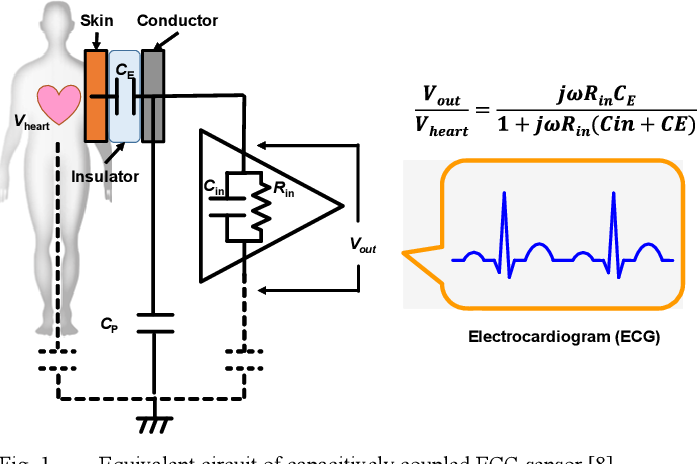
Polar H10 potentially uses two electrodes that make direct contact with the skin.
These electrodes are made of conductive materials potentially silver or silver chloride (Ag/AgCl) that can detect the small electrical signals generated by the heart.
This information can’t be proven because there is no in detail public information available about this sensor.
The electrodes in contact with the skin detect the small electrical signals generated by the heart's contractions, measuring the voltage difference between them to produce an electrocardiogram signal.
 width=”500”> [Nagasato et al., 2017]
PPG:
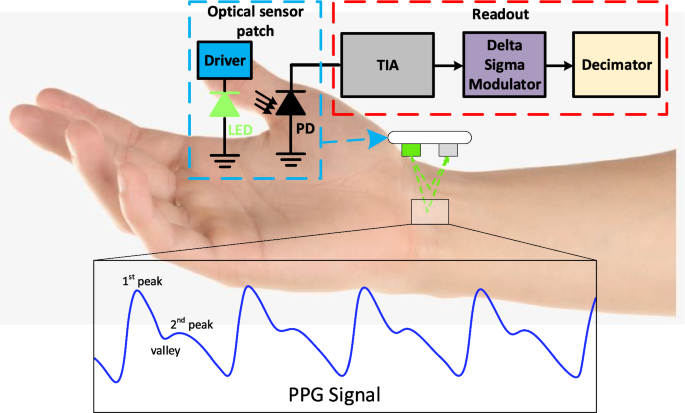
E4’s PPG sensor contains light-emitting diodes (LEDs) with a total 14 mm² sensitive area, that emit light into the skin.
As the heart pumps blood through the body, the volume of blood in the capillaries under the skin changes. This affects how much light is absorbed or reflected back to the photodiodes.